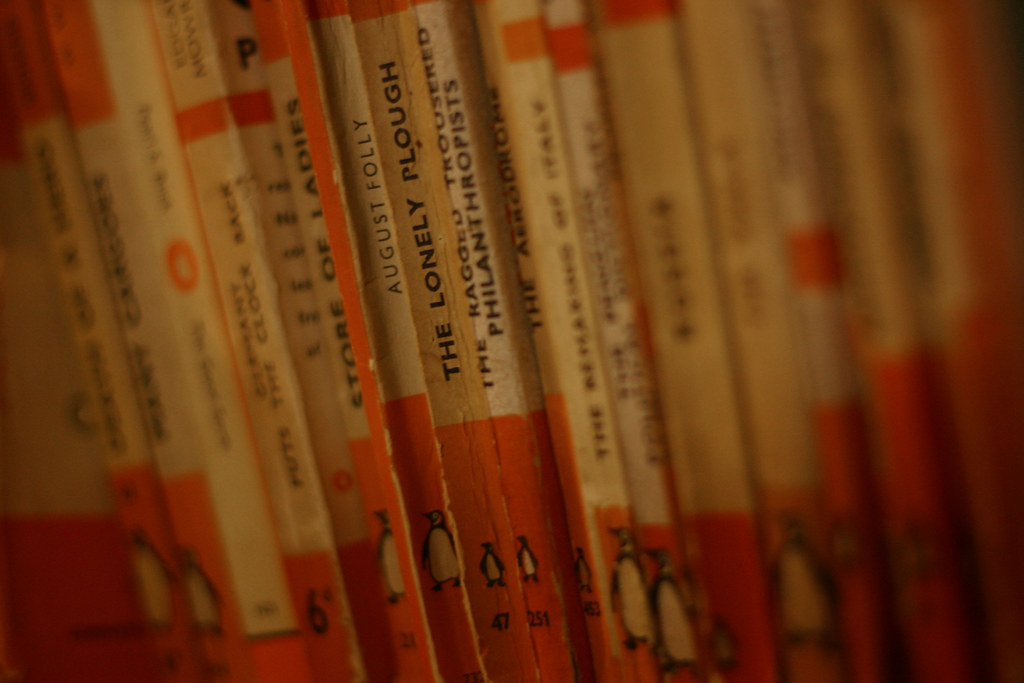
Marguerite Adler has read Penelope Fitzgerald's The Blue Flower seven times. The first reading was in 1998, in a hotel room in Edinburgh during a damp August conference. The seventh was in the autumn of 2025, on the same flight from Boston to Reykjavik on which she always seems to be reading Fitzgerald.
She does not recommend this practice. It is, she admits, slightly compulsive. She brings it up only because she wants to make a claim about re-reading that depends on having done a lot of it.
The claim is this. There are books which give up their best part only on the second reading, and one cannot, by reading carefully the first time, get around this.
The first reading of a book is, in her account, occupied with the basic work of orientation. Who is the narrator. Where are we. When. What is being attempted. By the time the reader is at home in the book, the book is two-thirds over.
The second reading begins at page one already at home. The reader knows the architecture. She is free, now, to attend to the things the first reading had no spare capacity for — the sentence rhythms, the small foreshadowings, the joke on page nine that pays off on page two hundred.
This is not a new claim. Nabokov made it. Helen Vendler made it. Sven Birkerts made it in a quieter way. Adler is not arguing for it on its merits, which she takes as given. She is arguing for the practical question of which books to re-read.
Not every book rewards a second reading. Plot-driven books, in particular, often do not. A detective novel one has solved is, mostly, over.
What rewards a second reading is the book in which the sentences carry as much weight as the events. Fitzgerald rewards re-reading because the sentences are dense with quiet information that the first reading cannot afford to slow down for.
Adler offers a working list, from her own life. She has re-read Marilynne Robinson's Gilead five times. She has re-read Alice Munro's Open Secrets three. She has re-read W. G. Sebald's The Rings of Saturn four times, and expects to read it again. She has re-read Rebecca West's Black Lamb and Grey Falcon, in pieces, more times than she can count.
She has not, she notes, re-read Anna Karenina, and probably should.
There are practical questions. How long to wait between readings. Whether to use the same physical copy. Whether to make new marginalia or to read the old ones first.
Her own rules are loose. Wait long enough that the book has gone slightly out of focus, which is usually two to five years. Use the same copy if possible, because the marginalia of one's earlier self are a record one cannot get any other way. Read the marginalia after, not before, so as not to bias the present reading.
She has, in a copy of The Blue Flower bought in 1998, marginalia in five different inks, from five of her seven readings. The other two readings were on a Kindle and an airline-loan paperback, neither of which yielded annotations.
The marginalia, taken together, are a kind of intellectual autobiography. Her twenty-eight-year-old self underlined sentences her fifty-six-year-old self finds embarrassing. Her thirty-seven-year-old self made a marginal note — this is the whole book — beside a passage her fifty-six-year-old self thinks is one of the weaker pages.
This is, she suggests, the second great gift of re-reading. The first gift is the book. The second is the record of one's previous selves in conversation with it.
She is not nostalgic about the previous selves. She does not, in re-reading, miss them or wish to be them. She finds them, in places, naïve, and in other places sharper than she now is.
What she values is the evidence that she has been, over twenty-eight years, a continuous reader of this one book, and that the book has been a kind of measuring stick.
There is a counter-argument, which she takes seriously. The counter-argument is that re-reading is a form of laziness — a way of avoiding the harder work of finding new books one has not yet read.
She does not fully refute this. She accepts that a reader who re-reads exclusively is in some sense limiting her own future. She would not want to be such a reader.
What she wants to argue for is the more modest position that a reader who never re-reads is missing a kind of reading that exists nowhere else, and that the books one chooses to re-read are, in the end, the books one actually believes in.
She is not sure she actually believes in ninety-four books a year. She is sure she believes in The Blue Flower.
On the next flight to Reykjavik she will read it for the eighth time. She does not expect it to disappoint her. It has not, so far, in twenty-eight years, and she is past the age of expecting it to start.