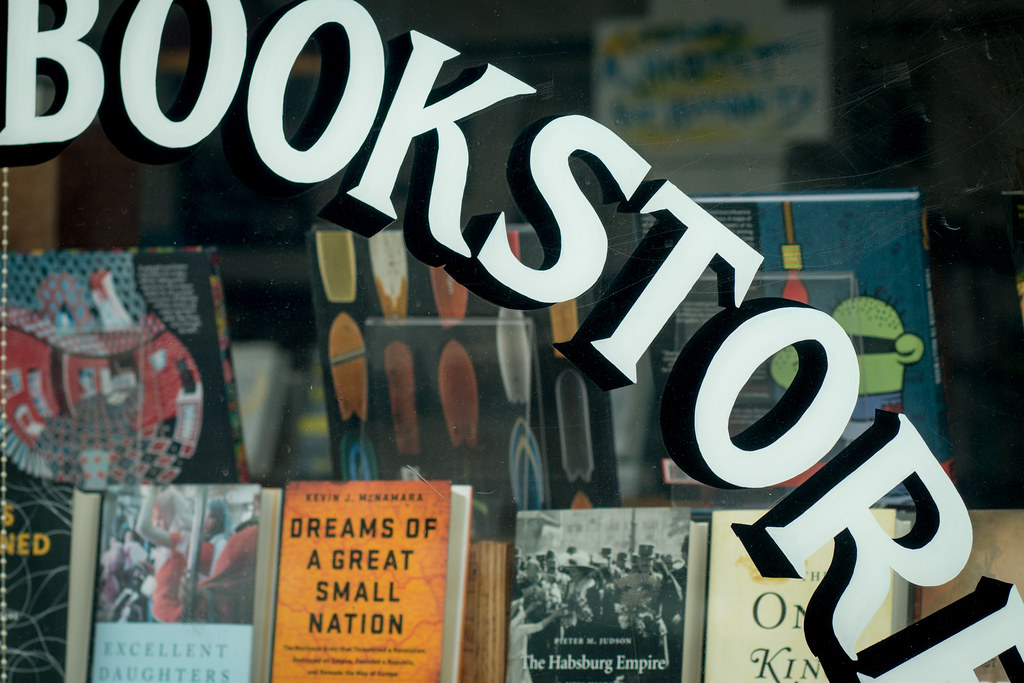
The poetry room at City Lights Booksellers is reached by a narrow wooden staircase that rises from the back of the main floor at 261 Columbus Avenue in the North Beach neighbourhood of San Francisco.
The staircase has seventeen steps. It creaks. The handrail is worn smooth in three places where seven decades of customers have laid their right hands on it.
City Lights was founded in 1953 by Lawrence Ferlinghetti and Peter D. Martin, on the model of European literary bookshops that the founders had encountered in Paris and elsewhere.
The shop has remained in continuous operation since then, has resisted multiple attempts at redevelopment by adjacent landlords, and has, since 2001, been protected by formal designation as a San Francisco landmark — the first business in the city's history to receive that status.
Ferlinghetti died in 2021 at the age of one hundred and one. The shop is now operated as a non-profit, with editorial direction maintained by a small board that includes several poets, two longtime booksellers, and a granddaughter of Ferlinghetti's first business partner.
The poetry room upstairs is the room most associated with the shop's identity. It is not, in fact, the largest section of the store. The main floor downstairs holds significantly more square footage, more inventory, and more daily foot traffic.
But the poetry room is the room one goes upstairs to find. It occupies the second floor in its entirety — perhaps fourteen by eighteen feet — with low ceilings, wooden shelves to head-height on all four walls, a single window overlooking Jack Kerouac Alley, and a small wooden bench against the south wall.
On an afternoon in mid-May, the room holds eleven people. This is, the bookseller at the downstairs till will later confirm, an unusually busy day. The room more often holds three or four.
Among the eleven: a man in his sixties holding a copy of Frank O'Hara's Lunch Poems; two young women, perhaps graduate students, taking turns reading lines aloud to each other from Anne Carson's Autobiography of Red; a tall, silent man inspecting the small-press section; and a couple in their forties from somewhere not San Francisco, by their conversation possibly Minneapolis, working their way slowly through the City Lights Pocket Poets imprint.
The Pocket Poets series is the imprint that made the shop's reputation. Ferlinghetti launched it in 1955 with his own Pictures of the Gone World, and the fourth title in the series — Allen Ginsberg's Howl and Other Poems, published in 1956 — became, after a celebrated obscenity trial in 1957, both a literary landmark and a commercial foundation that has carried the shop financially for sixty-nine years.
The Pocket Poets edition of Howl is still in print. It is still published in the same small, square format with the black-and-white cover Ferlinghetti designed. It still sells, according to the bookshop's general manager, between four and eight thousand copies a year out of this shop alone.
It is shelved on the poetry room's east wall, in the City Lights Publishing section, in chronological order alongside the rest of the Pocket Poets list. There are now sixty-three titles in the series.
The shop's editorial position has been consistent across seven decades: a commitment to international and outsider voices, to small-press and translated work, to the longer historical poetry tradition, and to a refusal of the merchandising tendencies that have shaped most contemporary American bookshops.
There are no tote bags in the poetry room. There are no mugs. There is a small rack of City Lights chapbooks priced between four and seven dollars, and there is the inventory itself.
On the south wall, beneath the window, the bench holds at any given time between one and three readers. A small placard above the bench, in Ferlinghetti's own handwriting from 1972, reads: Stairway to Poetry. Sit, read.
On the afternoon in question, the bench is occupied by a man in a brown corduroy jacket who has been reading the same forty pages of a Cesare Pavese volume for what the booksellers downstairs estimate is, by now, his fourth visit this week.
He does not buy the book. He has not bought the book on the previous three visits. The booksellers do not mind. The bench is, by design and by long tradition, a place for reading rather than purchasing.
Down on the main floor, the till is busy. A woman buys a paperback of Maggie Nelson's Bluets alongside a small-press collection of essays from Wave Books. A young man buys a Pocket Poets edition of Pier Paolo Pasolini's selected poems. Two tourists from Belgium buy a copy of Howl and a tote bag that says Banned Books on it.
The shop survives on a mix that the management has been refining for two decades: about sixty percent walk-up retail, twenty percent online sales, ten percent City Lights Publishing wholesale, and ten percent miscellaneous — events, foreign rights, occasional licensing of Ferlinghetti's image and writing.
The non-profit model, adopted in 2022, has stabilised the shop's finances after the difficult years of 2020 and 2021. It has not made the shop wealthy. It has, however, made the shop unsellable to any future developer, and that is, in the long view, the more important transition.
By 6 p.m., the poetry room has emptied. The corduroy-jacketed man has left without speaking. The graduate students have bought the Anne Carson and a thin chapbook from a Bay Area press called Litmus. The man with O'Hara has, after twenty minutes of consideration, also bought a copy of Lunch Poems.
The room is quiet. The window over Kerouac Alley shows the evening light on the brick wall opposite. A young bookseller comes upstairs, straightens the shelves, replaces three pulled books, and turns off the lights at 6:45.
The staircase creaks once on her way down. The shop closes at 11 p.m., as it has every night since 1953. There is no current plan to change the hours.