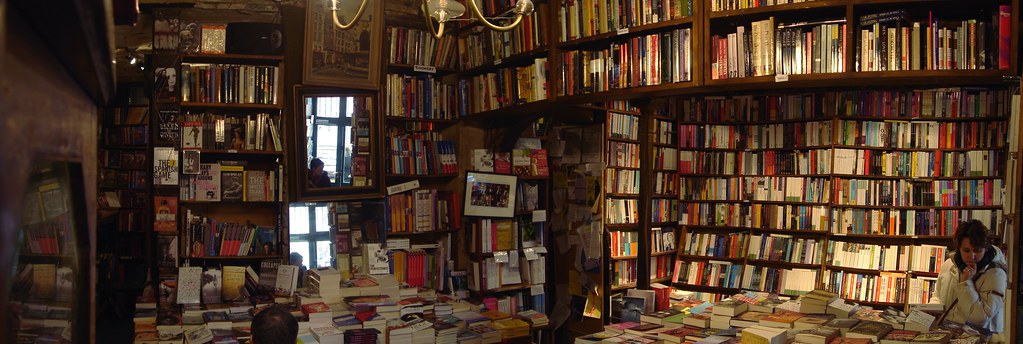
The shop at 37 rue de la Bûcherie, in the fifth arrondissement of Paris, has stood opposite Notre-Dame since 1951, when George Whitman opened a small English-language bookshop he initially called Le Mistral.
He renamed it Shakespeare and Company in 1964, with the blessing of Sylvia Beach, whose original shop of that name had operated on rue de l'Odéon between 1919 and 1941 and had famously published the first edition of Ulysses.
The current shop is not the original Shakespeare and Company. It is, by Whitman's own description, a tribute that became a continuation.
It is also, since George Whitman's death in 2011, run by his daughter Sylvia Whitman, named for the original proprietor and now in her early forties.
On a Tuesday morning in late May, the queue to enter the shop begins at 9:55 and extends, by the time the doors open at 10, around the corner toward the Seine. There are perhaps seventy people in it.
Most of them, the booksellers will later confirm, are tourists. Most will not buy a book.
This is not a complaint. The shop has, for at least three decades, been a literary tourist destination as much as a working bookshop, and its current operational model accommodates both functions in ways that are neither apologetic nor entirely seamless.
Roughly forty percent of the shop's daily visitors buy something. The average transaction is around twenty-two euros. The shop's total annual revenue is not publicly disclosed but is understood within the trade to be substantial — perhaps the highest per-square-foot revenue of any independent bookshop in continental Europe.
The shop's interior is small. Two principal rooms on the ground floor, a narrow staircase to the first floor, a small landing, and the famous reading rooms above. The total retail floor space is less than two hundred square metres.
Stock density is high. The shelves are double-stacked in many places. The fiction section runs floor-to-ceiling along three walls. The poetry section, at the back of the ground floor, is among the best-stocked English-language poetry sections in any bookshop in Europe.
The first floor is partly retail and partly residential. The reading rooms hold approximately eight thousand volumes — mostly second-hand, mostly unfor-sale, intended for the use of readers in the shop and of the so-called Tumbleweeds.
The Tumbleweeds are a tradition that George Whitman established in the 1950s: writers and students permitted to sleep in the shop in exchange for two hours of work a day, the reading of one book a day, and the writing of a one-page autobiography to be deposited in the shop's archive.
The shop now holds, by Sylvia Whitman's estimate, around thirty-five thousand of these one-page autobiographies, going back seven decades. They are kept in a small archive room on the first floor and are, technically, available to scholarly researchers by application, although the volume of the archive has made systematic study difficult.
Approximately forty Tumbleweeds are currently in residence on a rolling basis. They sleep on small beds tucked between the shelves of the reading rooms. They work shifts at the till, in the stockroom, and on the street outside.
On the Tuesday in question, the morning Tumbleweed at the till is a young Australian writer named Jess Marlowe, who is twenty-six, in Paris for six weeks, working on a novel set in the Pilbara. She has been at the shop for nine days.
Marlowe handles the morning rush — perhaps eighty customers between 10 and 12 — with a combination of professional courtesy and the bewilderment of someone who has not previously worked retail. She rings up a paperback of A Moveable Feast, a hardback of Patti Smith's Just Kids, a small City Lights edition of Ginsberg's Kaddish, and a tote bag with the shop's name on it, in that order, four times.
The tote bags and merchandising, sold on a small table near the door, account for a meaningful share of the shop's revenue. They subsidise, as the staff will quietly explain, the second-hand poetry section upstairs, which loses money on a per-square-foot basis but is part of the shop's editorial identity.
A Greek visitor in his fifties asks Marlowe whether the shop has any Cavafy in English. She walks him to the poetry section, finds two editions (Mendelsohn and Keeley & Sherrard), explains the difference between them as best she can from what she has been told by a senior bookseller named Henri, and leaves him to decide.
He buys the Mendelsohn. He pays in cash. He asks Marlowe to stamp the inside of the book with the shop's circular stamp — a kiss-mark logo with the words Shakespeare and Company, Kilometer Zero, Paris around the edge.
She does so. The stamp is, by a wide margin, the most-photographed object in the shop. It is the reason a meaningful percentage of visitors buy a book at all.
By 4 p.m. the shop has thinned. The reading rooms upstairs hold a handful of people — a graduate student reading Proust on the window seat, a Tumbleweed writing in a notebook on a bed, a tourist taking photographs of the piano in the central room.
The piano was installed by George Whitman in the 1960s. It is regularly played, badly, by visitors. The shop has not had it tuned since 2019. Sylvia Whitman has been told, repeatedly, that it needs tuning. She has, repeatedly, declined.
The shop closes at 8 p.m. on weekdays, later on weekends. The day's takings on the Tuesday are, by Marlowe's later account, around eleven thousand euros across roughly four hundred and twenty transactions.
After closing, the Tumbleweeds eat together at a long table in the upstairs kitchen. The meal is communal. The conversation is in five languages. The view from the kitchen window, across rue de la Bûcherie to the floodlit facade of Notre-Dame, is the view that has, more than any other single thing, made the shop a destination.
Marlowe, when asked, says the work is harder than she expected and the residency more valuable than she had hoped. She says she will write the autobiography on her last night.
She has, she says, eight days left.